
Automotive
Stainless steel in vehicles splits into two categories: heat-resistant (exhaust) and decorative. Their grade systems and acceptance criteria differ, and mixing them up costs you either money or a failure.
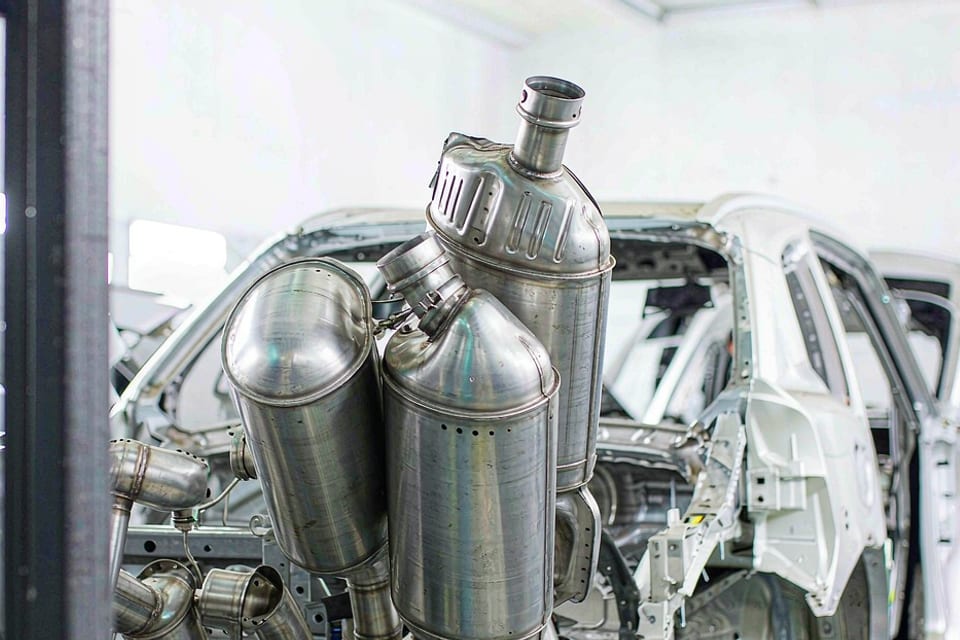
Typical Parts and Material Selection
| Part | Grade | Surface / Thickness | Watch Out For |
|---|---|---|---|
| Exhaust manifold / downpipe | 409 / 441 | 2B / 1D, 1.2–2.0 mm | High-temperature oxidation, thermal fatigue |
| Muffler / tailpipe | 409 / 436L | 8–1.5 mm | Condensate corrosion |
| Trim / bright molding | 304 / 430 | BA / 8K, 0.3–0.8 mm | Surface grade, no cracking at bends |
| Fuel tank / bracket | 304 / 441 | 0–2.0 mm | Formability, spot weldability |
| Seat frame | 301 / 304 | High-strength sheet 0.5–1.2 mm | Yield ratio, fatigue |
Three Real Bottlenecks in This Industry
In exhaust, "the more expensive the better" does not apply
409 is titanium-stabilized, cheaper and sufficient; 441 adds Nb+Ti for higher heat. Both mistakes are common: 304 in exhaust cracks at the weld due to thermal expansion, and 409 in the hot section scales up.
Deep drawing depends on r-value, not hardness
Trim parts need high r and low Δr. The same grade behaves very differently under different rolling schedules — always run a drawing trial before a batch, don't just read the mill certificate.
Electrode life sets your takt time
Stainless steel has high resistance and low conductivity, so spot-welding electrodes wear quickly. Plan electrode changes by weld count, and control incoming oil film and roughness.
Related Products
Need a Quote or Technical Support?
Send us the part, grade, size, quantity and destination port — we respond within 24 hours with FOB / CIF.